

Ever since we debuted Bridge Grades for this 119th Congress late last month, I’ve been meaning to zoom into the data to better understand who’s who within the remaining competitive House districts for next year’s mid-term elections.
I say “remaining” because of the 435 districts, a whopping 84% of them are already considered forgone conclusions by political experts (Cook Political) due to strong partisan leans within the voters inside the district lines. And, this was before the gerrymandering gamesmanship which risks further reducing competitive districts to just 59 overall.
Bridgers are under attack
Our thesis, outlined in the short video below, is that the culture of Congress will change when citizens re-elect bridgers and vote out dividers systematically over time.
The trouble is, of the 59 competitive districts, 44 of incumbents are currently rated as bridgers (Grades As and Bs) while just 15 up for re-election are dividers (Grades Cs and Fs).
Bridgers from both parties are under threat
Of the 59 "in play” (and not expected to be gerrymandered) here’s the party breakdown by grade.
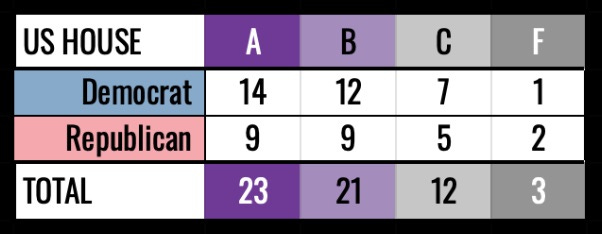
That 75% of incumbents in competitive races (44 of 59) are bridgers should be contextualized by reminding you that by design, Bridge Grades doles out 50% As and Bs and 50% Cs and Fs.
More simply, this 75% figure indicates that a disproportionate percentage of bridgers face close races than dividers. Which is not great news.
Why it matters
At the highest level, consider the “balance of powers” in our Founders’ design.
When an Executive Branch grabs power with an assist from a complicit Judicial Branch, our Founding Fathers intended the Legislative Branch to intervene as a counter-balance. The problem is, today’s incentives within the Legislative Branch are perverse, and the mutually beneficial partisan duopoly keeps legislators stuck playing tug-of-war.
To shift the composition of Congress toward a more collaborative win-win seeking culture and stronger body, citizens need to support, protect, defend, and elect bridgers (from both parties), while tossing out the dividers who blew their shot and demonstrated themselves to put party ahead of country.
To make systematic change over time, every election cycle, we’ll need to re-elect bridgers, and vote out dividers every chance we get.
The meager opportunity offered in the next election cycle is admittedly extremely discouraging as there are so few elections where citizen voters can make a difference. Still, change starts with these mid-term races in 59 (or so) districts next year.
Follow along (subscribe), and I’ll keep you updated as we track these elections and invite and encourage (anti-partisan, disenfranchised, non-voting) Americans to return to civics and help re-elect bridgers and vote-out dividers everywhere.
Bridge Grades is a citizen-led public utility. Our ambition is to build a durable system that can remain protected from big money or special interests. Bridge Grades are designed to be open-source, crowdsourced, and independently governed. We are part way on a multi-year journey to get there. We are a fiscally sponsored project of Mediators Foundation and all contributions to Bridge Grades are tax-deductible.
Insightful piece, thank you for sharing this research